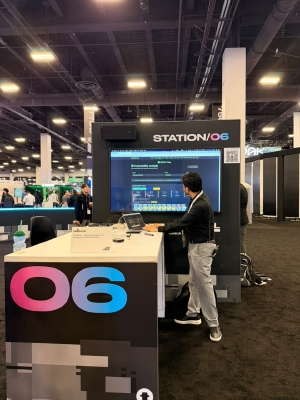
Presented at the Black Hat USA 2026 Arsenal on Thursday, August 6, 2026 (2:50pm to 3:50pm, Arsenal Station 6 in the Business Hall, Code Assessment track), the session walked attendees through SBOM Play, an SBOM exploration and intelligence extraction platform that runs entirely in the browser. It was the tool’s third Arsenal appearance, following Black Hat Europe 2025 and Black Hat Asia 2026, and the USA demonstration showed a build with added depth: government-baseline SBOM audits, enrichment findings, a combined tech-health score, and an on-device AI analyst. The format was live demonstration, with the deck serving as caption slides for the product on screen.
Summary
The session set out to show what an organization can actually do with the SBOMs it already has. The framing held that an SBOM is an inventory, and inventories become useful when they are queryable across many repositories at once rather than read one project at a time. Everything demonstrated happened inside a browser tab: the tool ships as a client-side application with no backend, and analysis results persist in the browser’s own storage.
The demonstration started from the input screen. A single field accepts a GitHub organization, username, repository, or full URL; the only requirement is that Dependency Graph is enabled on the targeted repositories, and an optional GitHub token exists purely to raise rate limits. Behind the scenes the browser queries the GitHub Dependency Graph API, resolves the full dependency tree using public registries such as npm and PyPI plus OSV.dev vulnerability data, renders the results across a set of interactive views, and stores everything locally in IndexedDB.
The bulk of the hour went to the views. A statistics dashboard aggregated the demo estate of 18 repositories and 2,450 dependencies, splitting npm, PyPI, Maven, RubyGems, and GitHub Actions as the leading ecosystems. The dependency view distinguished 309 direct from 2,141 transitive dependencies and offered filters for vulnerability, sponsorship status, major and minor version drift, maintenance state, and end-of-life. The vulnerability view showed a single transitive package, apache-airflow@3.1.8, carrying 75 vulnerabilities while drifting minor versions behind its upstream, with the full path from the affected repository traced on screen. The repository view graded each repository’s SBOM and paired it with per-repo vulnerability, dependency, author, and license counts. Version sprawl and common-dependency screens showed the same packages appearing in many versions, or in the same few versions, across the estate.
License and maintainer intelligence followed. The license compliance view counted unlicensed, copyleft, unknown, and custom licenses across the dependency tree and flagged 2 version-to-version license changes, demonstrated through JUnit’s move from CPAL 1.0 and CPL 1.0 at version 4.5 to EPL 1.0 at 4.12. The author view aggregated 353 human maintainers across 7 ecosystems, marked top repository contributors as tentative authors, kept automated bots separate, and mapped self-reported maintainer locations worldwide.
The closing segment showed the tool’s newer scoring layers. The SBOM audit graded all 18 demo repositories D, measured 54 percent average completeness, and found zero compliance with the CISA 2025, BSI TR-03183, and CERT-In baselines, making the point that having SBOMs is not the same as having usable ones. The findings view enumerated 479 enrichment findings, among them 7 known malicious packages, mutable GitHub Actions tags, dependency confusion candidates, and a large end-of-life population. The insights view rolled the estate into a 65/100 tech-health score. Finally, the SBOM Analyst Agent answered questions about the analyzed estate using the Gemini Nano model built into Google Chrome, so the AI step also stayed on-device with no network call. The session closed with the live deployment and the source repository.
Key Themes
- SBOMs Beyond Vulnerability Tracking: the platform exists to extract tech debt, license, maintainer, and lifecycle intelligence from SBOM data, with CVEs as one view among many.
- Everything In The Browser: fetching, resolution, analysis, and storage run client-side with no backend, and results persist in IndexedDB on the user’s machine.
- Frictionless Entry: one input field accepting a GitHub org, user, repo, or URL, with Dependency Graph enabled as the only prerequisite.
- Organization-Scale Views: version sprawl, common dependencies, and drift only become visible when many repositories are analyzed together.
- Licenses As A Moving Target: compliance counting is paired with detection of license changes between package versions, catching permissive-to-copyleft shifts.
- Maintainers As Part Of The Attack Surface: author aggregation, tentative contributor attribution, bot separation, and location mapping expose maintainer risk and sponsorship opportunities.
- Scoring SBOM Quality And Estate Health: audits against CISA 2025, BSI TR-03183, and CERT-In baselines plus a tech-health score convert raw SBOM data into measurable posture.
- AI Without A Cloud: the analyst agent runs on Chrome’s built-in Gemini Nano, keeping questions, answers, and SBOM data local.
Notable Points
- The session slot ran 2:50pm to 3:50pm on August 6, 2026, at Arsenal Station 6 in the Business Hall, under the Code Assessment track.
- The demo estate totaled 18 repositories and 2,450 dependencies; the dashboard reported 1,815 vulnerabilities and 2,364 licensed dependencies alongside 86 unlicensed ones.
- Dependency split: 309 direct versus 2,141 transitive; the ecosystem leaders were npm (1,365), PyPI (649), Maven (339), RubyGems (35), and GitHub Actions (16).
- Worked vulnerability example: apache-airflow@3.1.8, a transitive dependency, carried 75 vulnerabilities and trailed its upstream by a minor version (3.3.0 available).
- Version sprawl example: org.slf4j:slf4j-api appeared in 10 versions across the estate, with flask, commons-lang3, and plexus-utils at 6 versions each.
- License change example: JUnit 4.5 under CPAL 1.0 and CPL 1.0 versus JUnit 4.12 under EPL 1.0; the audit found 2 such transitions overall.
- Audit outcome: all 18 repositories had SBOMs, all graded D, average completeness was 54 percent, and compliance with CISA 2025, BSI TR-03183, and CERT-In baselines was 0/18.
- Findings summary: 479 total, including 7 known malicious packages, 42 mutable GitHub Actions tag references, 6 potential dependency confusion cases, and 424 end-of-life or end-of-support components (323 rated highly likely abandoned).
- Tech-health score for the demo estate: 65/100 (grade C), with 357 critical and high vulnerabilities, a 331-day median CVE dwell time, 870 major drift cases, and 100 high-risk licenses.
- The AI segment ran on Gemini Nano inside Google Chrome (model v3Nano, version 2025.06.30.1229), requiring no network call and reading SBOM data from local IndexedDB.
Notable Quotes
“SBOM is just an inventory”
“Showing is better then talking”
“One Field : As simple as it can get”
“P.S. We just need Dependency Graph enabled on repositories.”
“All analysis happens in your browser. No data is sent to any server.”
“So, all activities are happening in browser no network call”