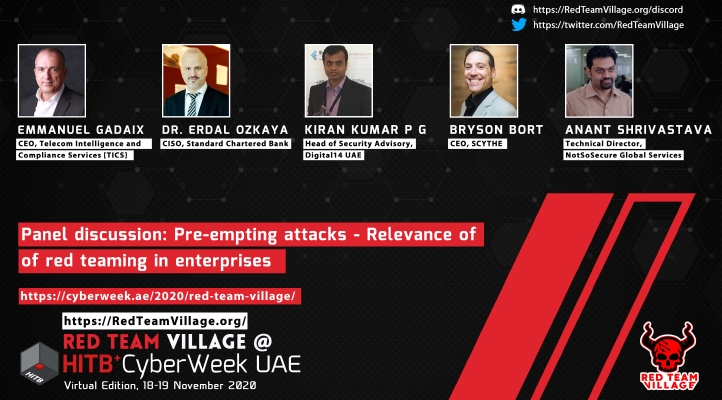
Pre-empting attacks - Relevance of red teaming in enterprises
HITB Cyber Week Dubai: Red Team Village
18 November 2020
AI Generated Summary
AI Generated Content Disclaimer
Note: This summary is AI-generated and may contain inaccuracies, errors, or omissions. If you spot any issues, please contact the site owner for corrections. Errors or omissions are unintended.
This panel discussion from HITB Cyber Week Dubai explores the relevance of red teaming in enterprises, covering why it’s important, how to get budget approval, common pitfalls, and how to resolve conflicts between red and blue teams.
Panelists
Emmanuel: 30 years in security industry, specializing in telecommunications, mobile networks
Dr. Erdell: Regional CISO at Standard Bank, loves community, believes events help share voice
Kiran: Head of Technical Security Advisory for Digital 14, part of corporate information security team, manages team of security operations, penetration testing, incident response, speaks at multiple global cybersecurity conferences
Bryson: Former army officer, founded consultancy Grimm 8 years ago, spun out adversary emulation platform Scythe, co-founder of ICS Village (non-profit on critical infrastructure), senior fellow in cybersecurity and emergent threats, advisor to Army Cyber Institute
Anant Shrivastava: Technical team within NotSoSecure Global Services (part of Claranet Group), deals with threat teaming, pen testing, DevSecOps initiatives
Key Topics Discussed
Why Red Teaming is Important for Enterprise:
Military games analogy: Matters same way military games matter - don’t get to war every day but train all the time
Best way to uncover unknown unknowns
Must translate to business language - talk dollars, not CVEs
Three core elements of attack chain: Reconnaissance, Access, Post access
Business value increases down the phases - recon has least business value, post access has most
How to Convince People Who Control the Purse:
“You can either spend a hundred now or use a million later”
Link back to dollar value and reputation factor with findings impacting business
Show tangible results - demonstrate impact on payment gateways, ATM switches, critical applications
Two kinds of companies: leadership cares, leadership doesn’t care
Red teaming is not compliance focused - it’s understanding what will happen with real-world adversary
Purple Teaming:
Evolution of red teaming - collaborative culture, get results as you go
Decide in advance what to test, use milestone-oriented fashion together
Blue team and defense sitting there going “We didn’t see that” - dial in detections, validate, move on
Improving as you go - everybody’s part of that
Major Pitfalls:
Cannot approach same way in every organization
Scope matters - define activities and target systems