As part of HITB Cyber Week Dubai, I presented a Talk at Red Team Village
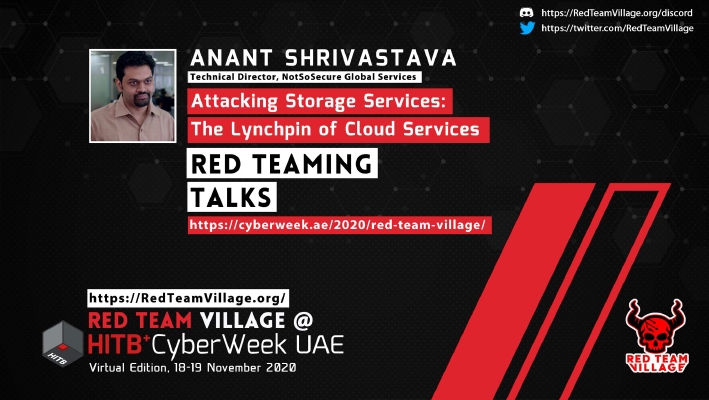
As part of HITB Cyber Week Dubai, I presented a Talk at Red Team Village
AI Generated Content Disclaimer
Note: This summary is AI-generated and may contain inaccuracies, errors, or omissions. If you spot any issues, please contact the site owner for corrections. Errors or omissions are unintended.
A presentation from HITB CyberWeek 2020 (Red Team Village) examining how cloud storage services serve as the lynchpin of cloud infrastructure and why they represent a critical attack surface. The presenter, then Technical Director at NotSoSecure Global Services, walks through real-world case studies spanning AWS, Azure and GCP, presents a structured attack methodology from enumeration through post-exploitation, and lays out defenses that both cloud vendors and tenants should implement. The central argument: cloud storage is the linchpin of cloud services, a critical component that, when compromised, enables massive organizational damage because virtually every other cloud service depends on it.
The talk opens with cloud storage’s central role. Beyond obvious file storage, cloud storage services across AWS S3, Azure Storage, GCP Storage, Digital Ocean Spaces, SharePoint, OneDrive, Dropbox, Google Drive, GitHub and Bitbucket underpin virtually all cloud operations. The talk likens it to an external disk attached to a laptop. PaaS and FaaS environments keep source code in storage containers and pull it when new instances spin up, so higher-level storage access cascades into massive organizational damage.
The case studies are drawn from real incidents. An early study found 10% of surveyed S3 buckets public and 20% of those world-writable, from Booz Allen Hamilton to WWE to Dow Jones. The HackerOne 2016 case: a security vendor’s own S3 bucket was writable by any authenticated AWS user, enabling social engineering via planted documents. The Rocket.chat incident: an installer referenced an unclaimed bucket an ethical hacker claimed, serving malicious content to anyone running it, and installers run with sudo. Most dramatically, the Linux Vendor Firmware Service (LVFS) case combined an unclaimed bucket with a PGP signature bypass, drawing 2.5 million update requests from 500,000 unique IPs over 26 days.
Enumeration exploits global name uniqueness per provider and predictable company-name suffixes, making brute-force enumeration viable. Cloud Enum builds mutation lists and checks AWS, Azure and GCP at once, S3 error messages reveal the correct region, and other paths include Cloud Scraper (website HTML extraction), GrayHat Warfare (public bucket search) and Google dorking.
Azure SAS (Shared Access Signature) URLs grant container-level or storage-level access, contrary to common assumption: a signature pointing to one JPG opens the whole account. Loading one SAS URL into Azure Storage Explorer revealed another container with Azure Function source code; planting a backdoor meant waiting for the next invocation. Leaked Azure storage keys were searchable on GitHub via the DefaultEndpointsProtocol keyword, with 64,479 hits at the time of the talk.
Post-exploitation includes harvesting credentials from document metadata with FOCA or ExifTool, backdooring PaaS/FaaS source code, and extracting secrets for lateral movement. The SSRF-to-EC2 chain: an SSRF bug yields metadata credentials, storage access reveals 200 PEM key pairs mapped by server name, and it escalates to IAM admin. A similar Elastic Beanstalk attack exploited predictable bucket naming to backdoor a website within minutes. The Cognito research covered 2,504 identity pools, more than 1 in 5 insecure, exposing 906 S3 buckets and 1,572 Lambda functions with at least 78 sensitive environment variables.
Defenses follow shared responsibility: vendor automation like AWS Config auto-remediation, tenant-side least-privilege IAM, awareness that “authenticated user” means anyone on the platform, Scout Suite scans, and chaos engineering to validate controls.
“Cloud storage is the linchpin for cloud services.” 3:31
“Consider cloud storage as an external disk connected to your laptop. Just like you keep data in that external disk, that is exactly how cloud storage operates.” 3:38
“If you have higher level access over cloud storage, you can do massive damage to the organization, to the environment.” 4:55
“Contrary to what people might think, the SAS URLs are container level URLs or storage level URLs. They are not URLs pointing to one specific resource.” 24:10
“Identity and access management and the data is always going to be a tenant responsibility. And that’s where the major problem is.” 12:08
“Authenticated user is not the setting that you want in almost 99.99% of the scenarios.” 33:23
“However people gently uncheck it or change the settings later on without realizing what content is available within the bucket.” 34:30
“Simulate a hack, see the reactions of your system, and if those reactions are not up to the mark at which you wanted them to be, then go ahead and fine tune those.” 38:37