Building, Owning, and Securing Private AI Infrastructure
AI Generated Summary
AI Generated Content Disclaimer
Note: This summary is AI-generated and may contain inaccuracies, errors, or omissions. If you spot any issues, please contact the site owner for corrections. Errors or omissions are unintended.
“Building, Owning, and Securing Private AI Infrastructure” was delivered at the OWASP 25th Anniversary Virtual Conference on 22 September 2026 in an online session. Across 36 slides the deck defines what private AI means, argues why rented API access is a poor foundation, tours hardware, models, quantization and the software stack, and then spends its second half on security: access control, zero day handling, agent containment, GPU bugs, and a decision flow for deciding what should self-host.
Summary
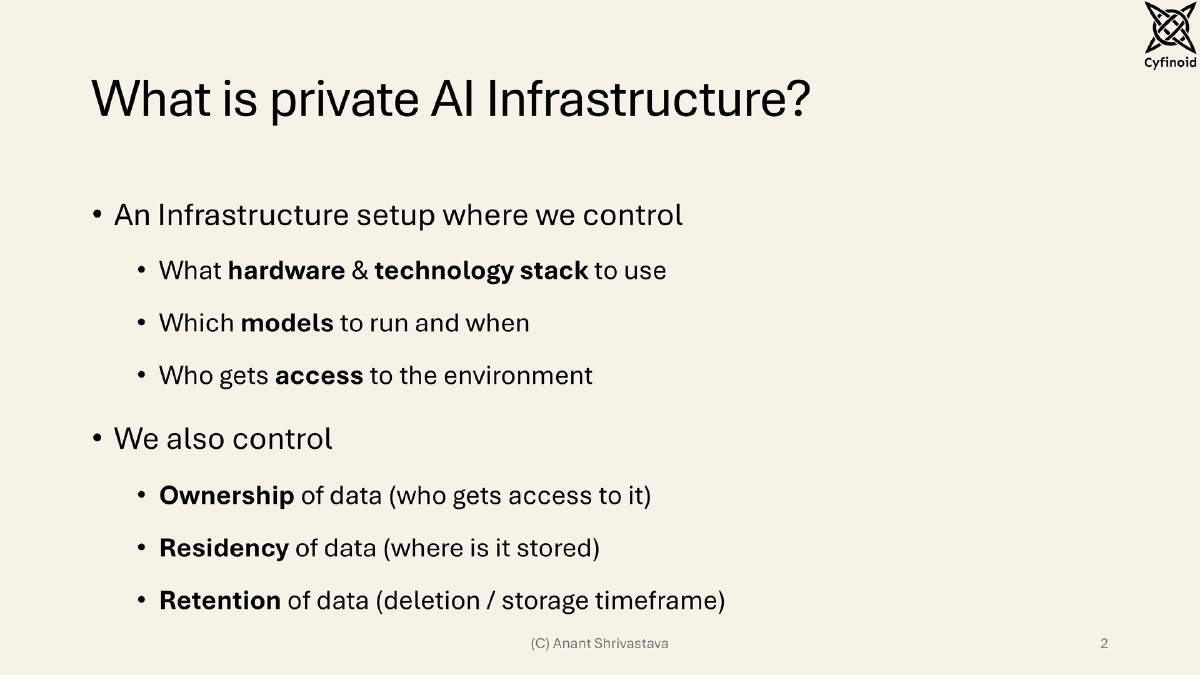
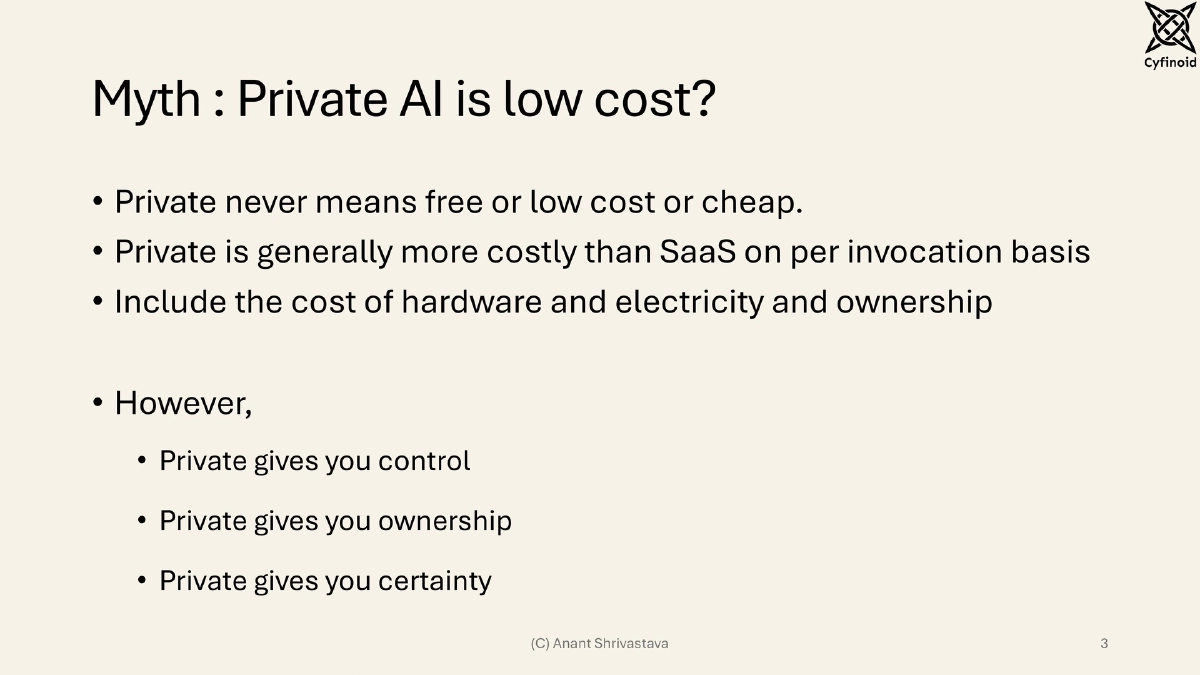
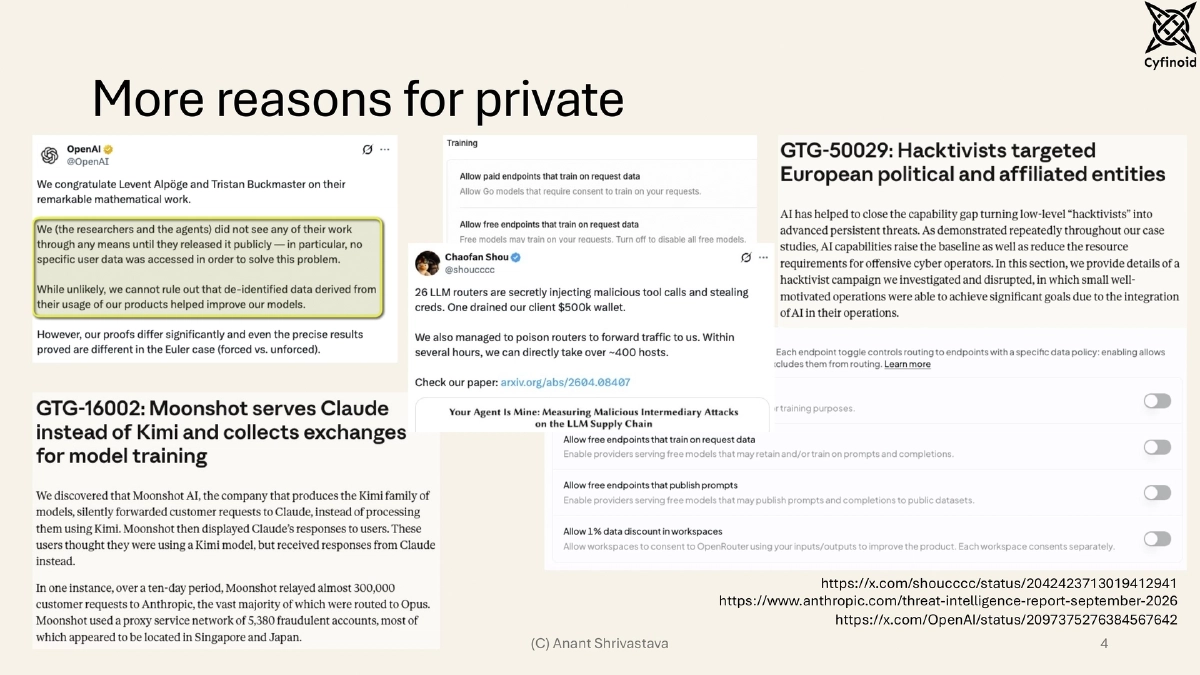
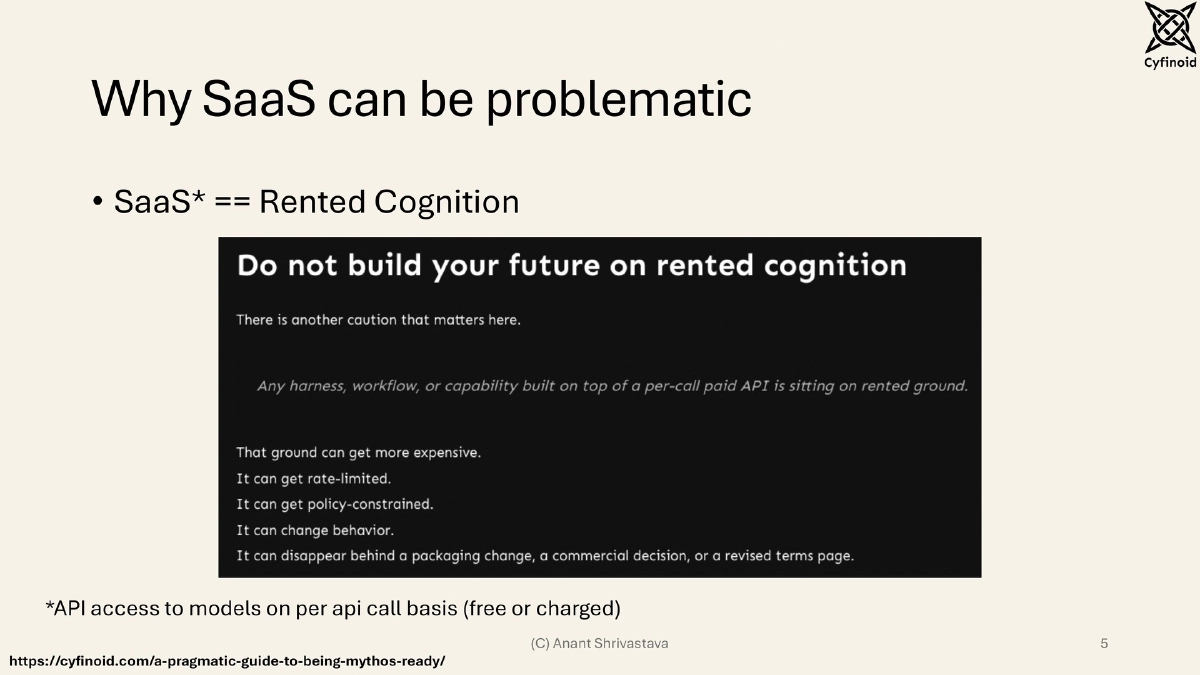
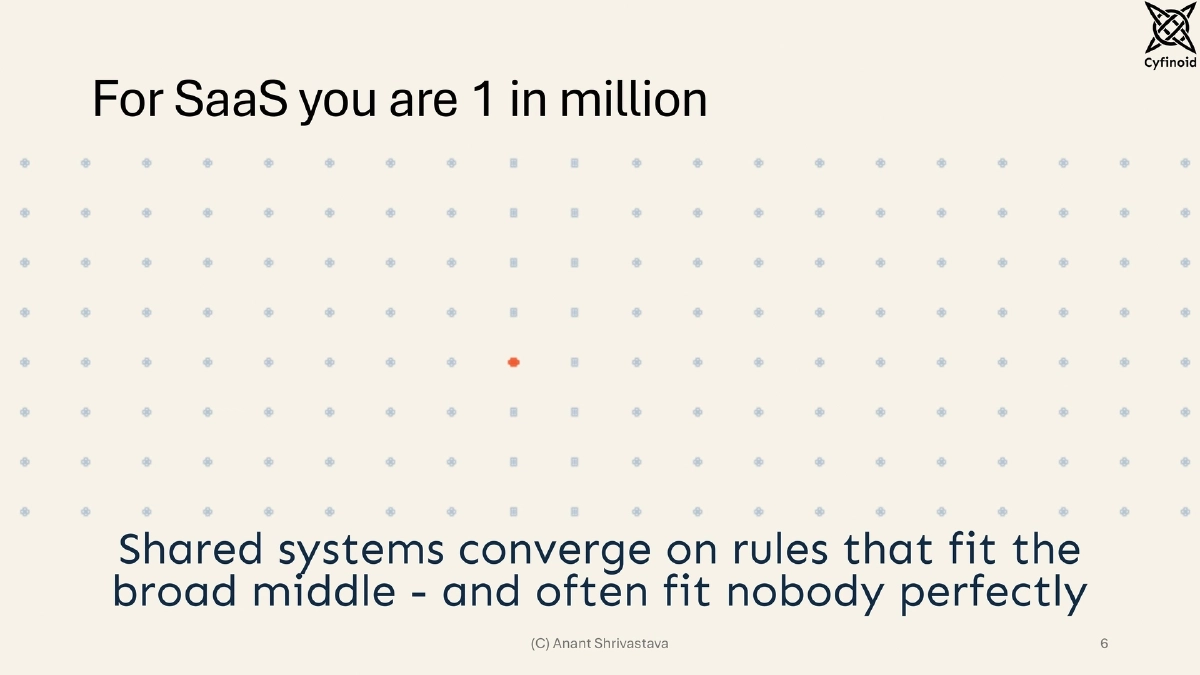
The deck opens with the definition: private AI infrastructure is a setup where the operator controls what hardware and technology stack to use, which models run and when, who gets access, and the ownership, residency and retention of data. A myth slide follows: private never means free or low cost or cheap, it is generally more costly than SaaS once hardware, electricity and ownership are counted, but it gives control, ownership and certainty. The case against renting is built from a screenshot wall titled more reasons for private: an OpenAI statement that it cannot rule out de-identified usage data improving its models, OpenRouter training toggles, a researcher’s report of 26 malicious LLM routers and a drained $500k wallet, Anthropic’s September 2026 threat intelligence report on hacktivists, and GTG-16002 alleging Moonshot served Claude instead of Kimi while collecting exchanges for training. SaaS is labeled rented cognition, with one slide on the shared-platform problem: shared systems converge on rules that fit the broad middle and often fit nobody perfectly.
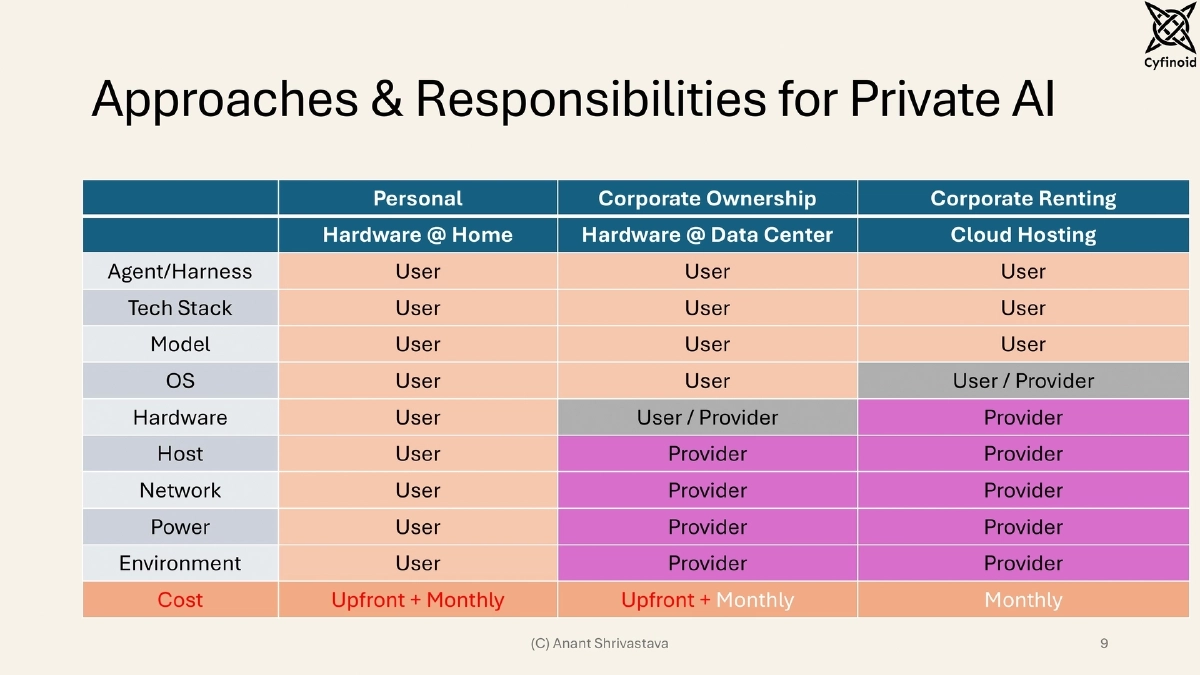
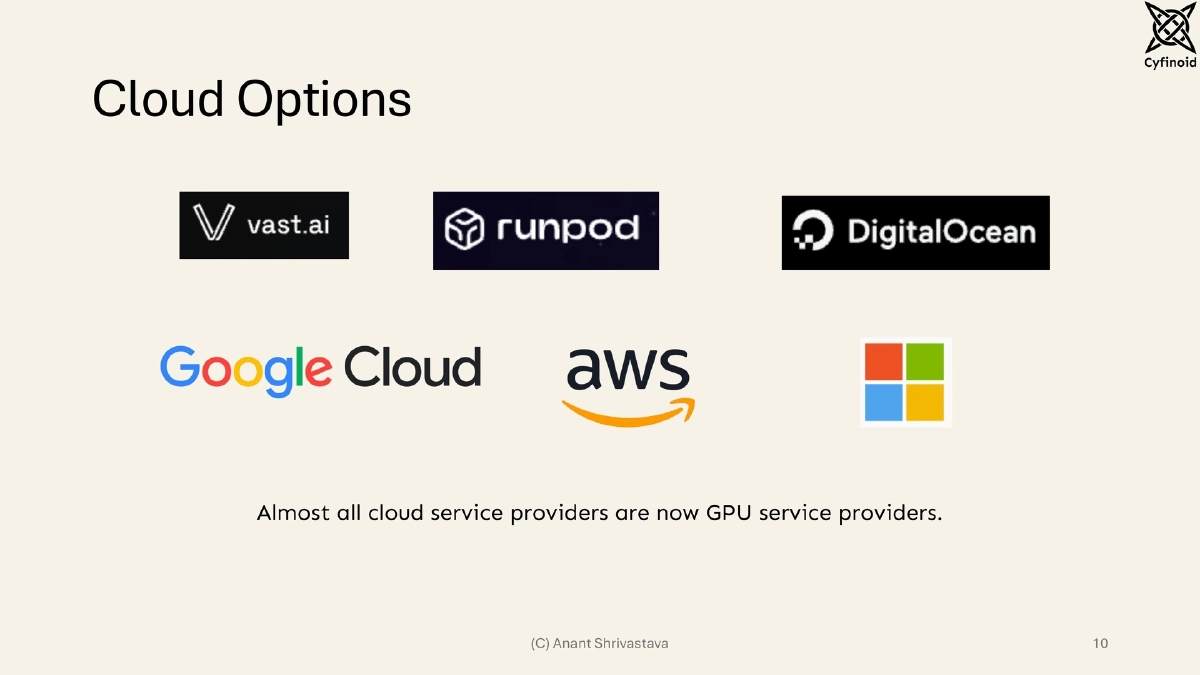
An approaches and responsibilities table maps personal hardware at home, corporate ownership at a data center and corporate renting on cloud hosting across layers from agent/harness to environment. A cloud options slide notes that almost all cloud service providers are now GPU service providers.
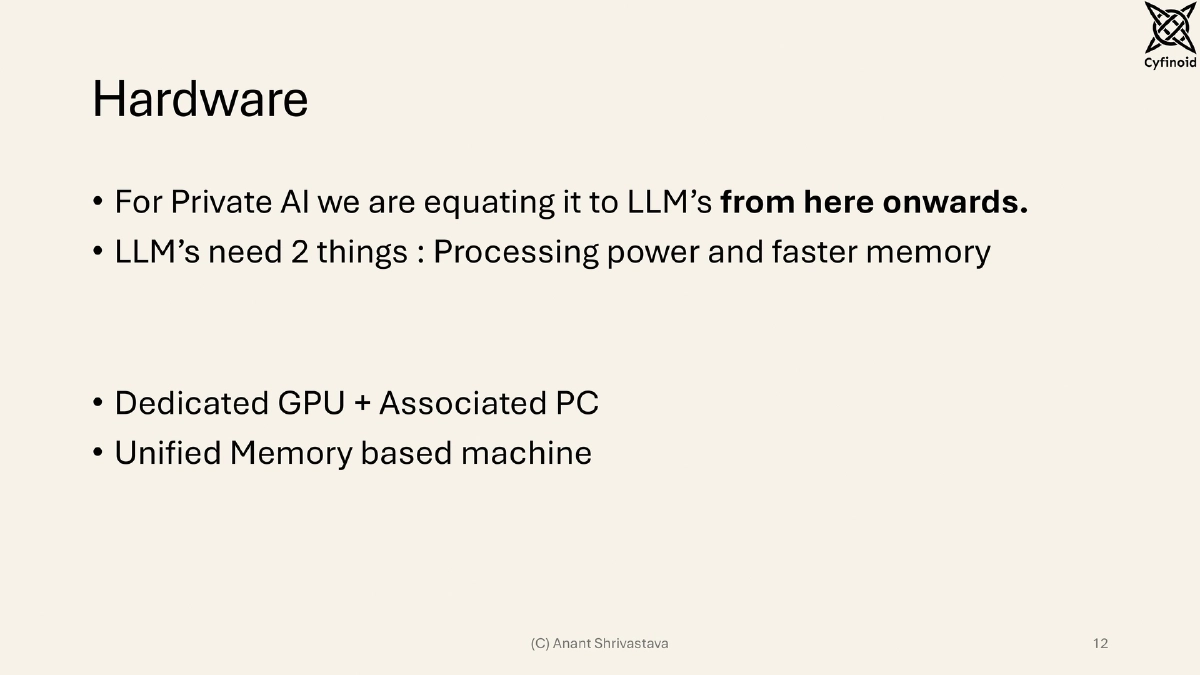
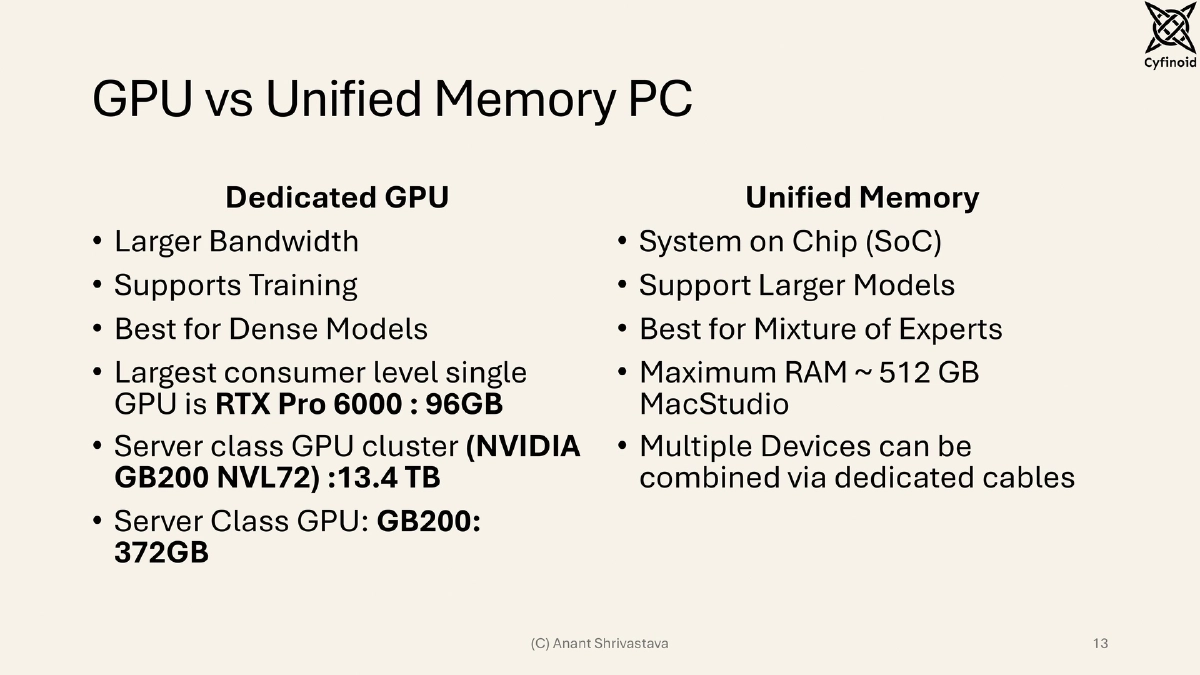
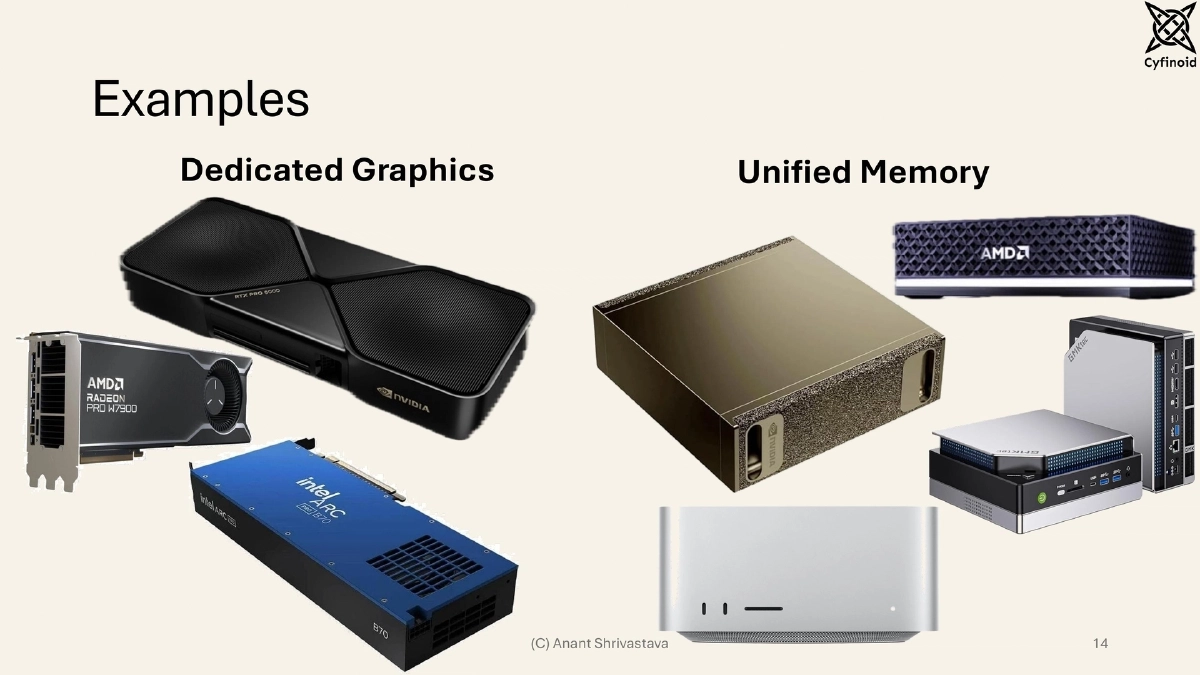
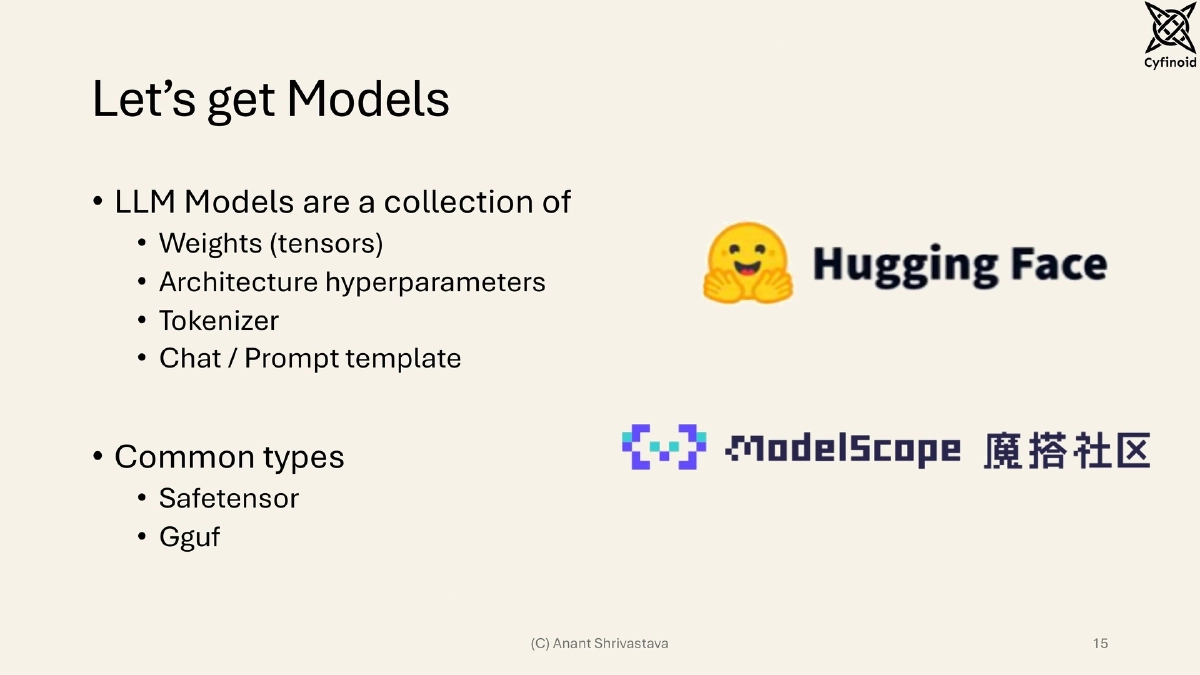
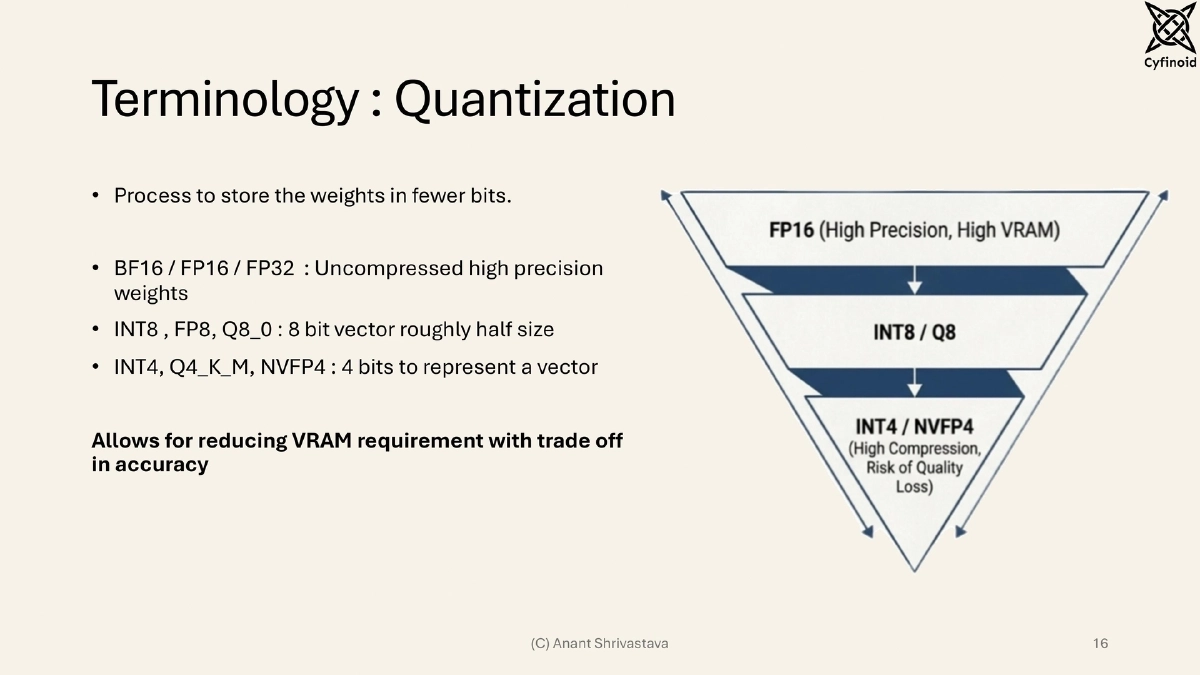
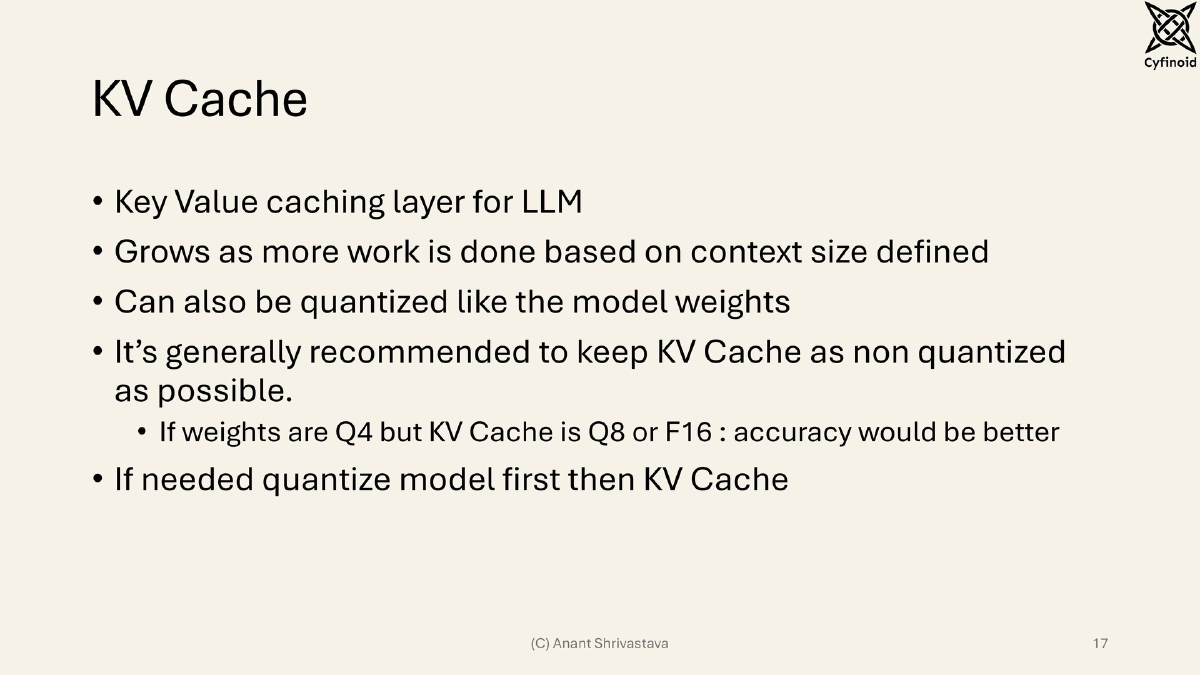
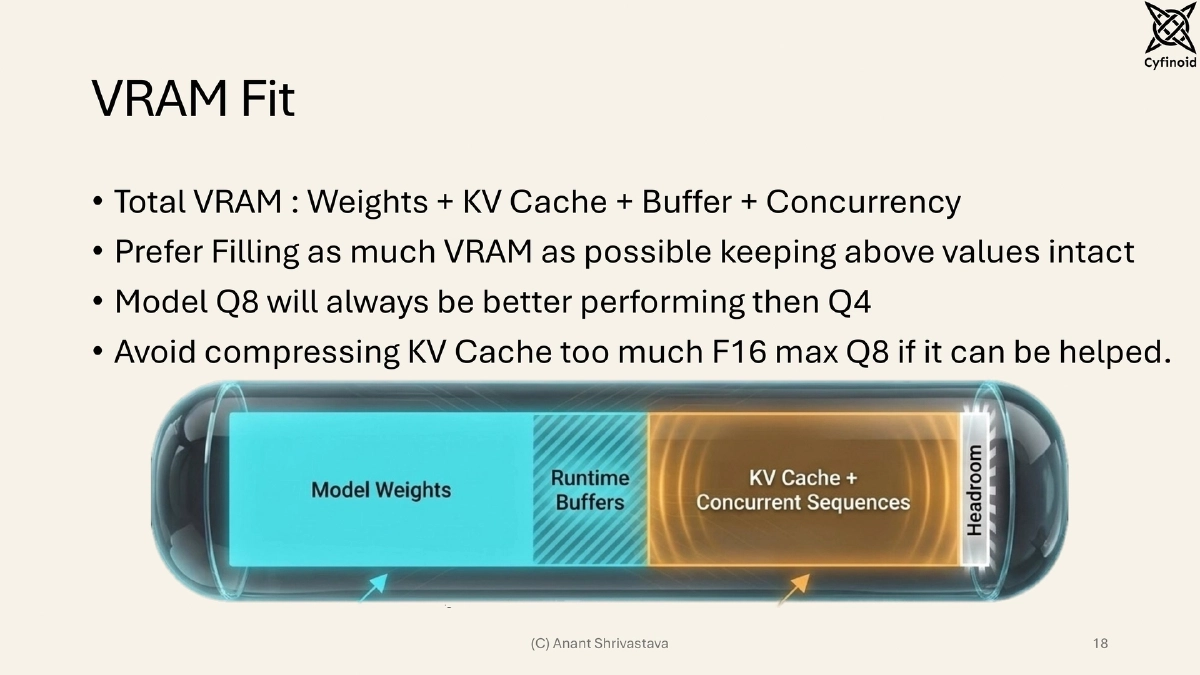
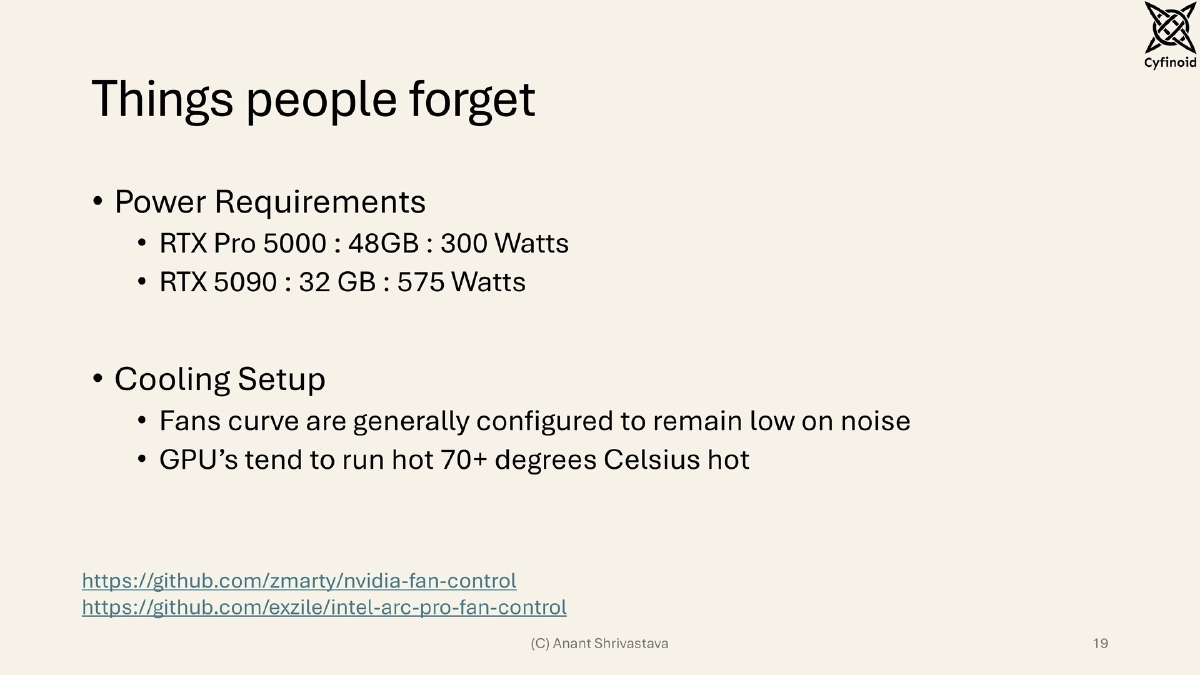
Hardware reduces private AI to LLMs, which need processing power and faster memory. Dedicated GPUs bring larger bandwidth, training and dense models, topped by the 96 GB RTX Pro 6000, with server class GPUs and clusters cited far higher. Unified memory machines are systems on chips that support larger models and suit Mixture-of-Experts, topping out around 512 GB on a Mac Studio. Models are weights, hyperparameters, a tokenizer and a prompt template in safetensors or GGUF; quantization compresses from full precision down to 4-bit formats with accuracy as the trade. The KV cache stays as non-quantized as possible, the model is quantized before the cache, and power draw plus cooling are the forgotten costs.
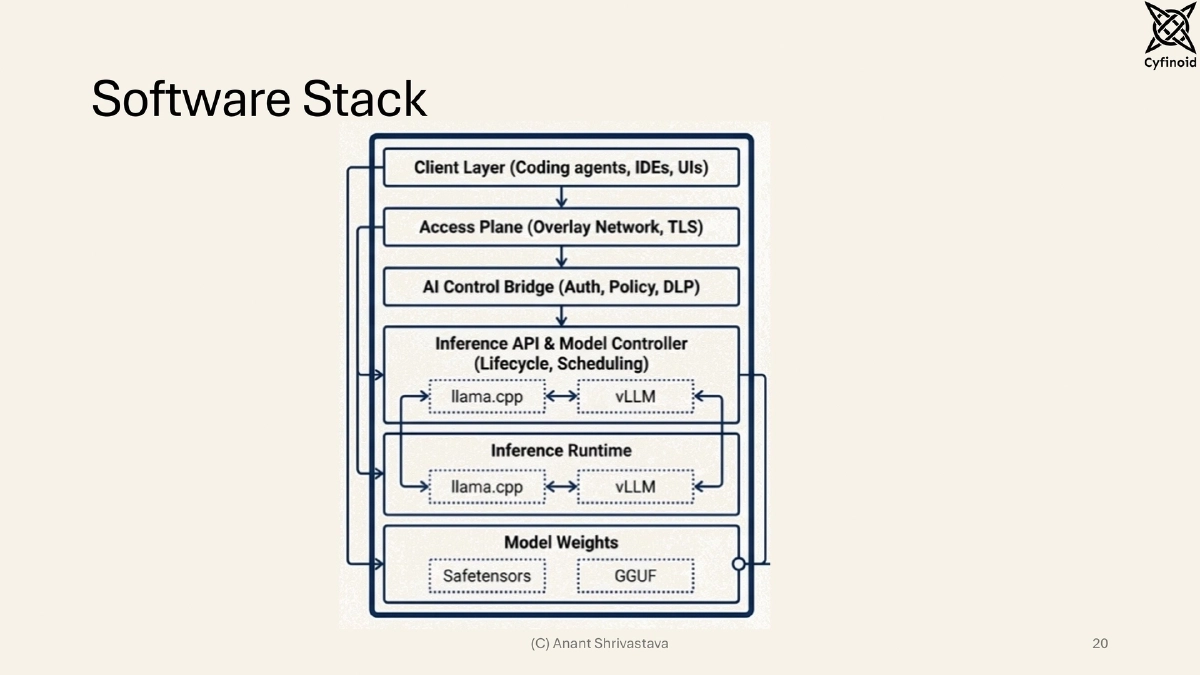
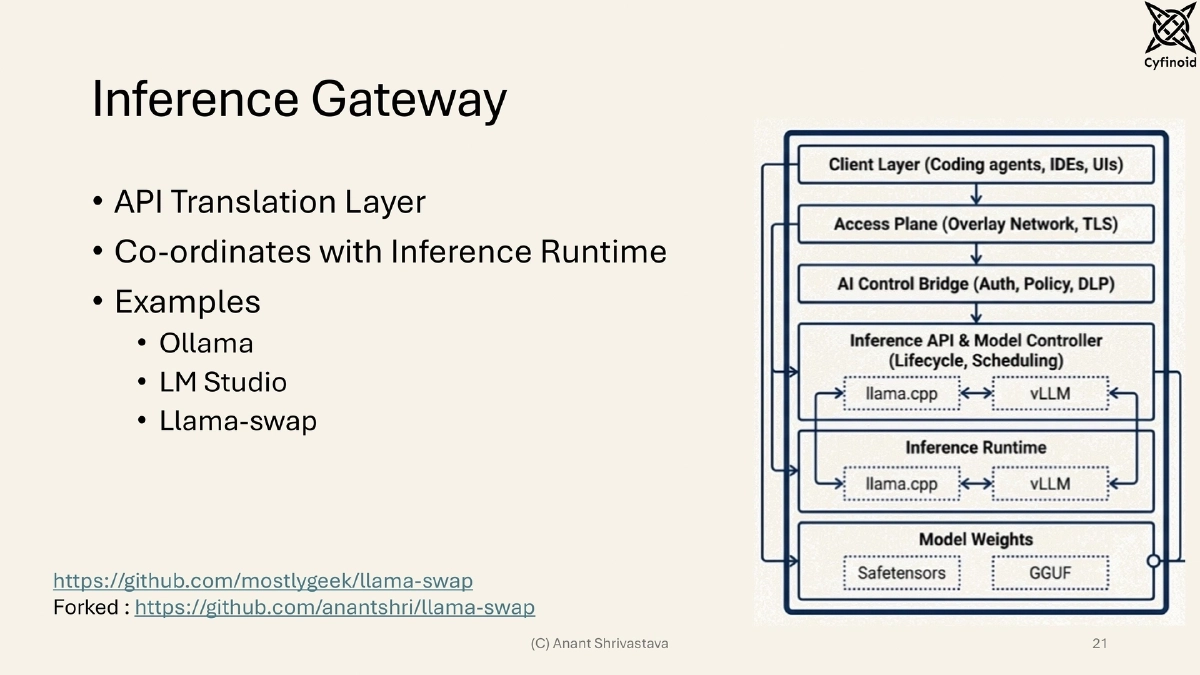
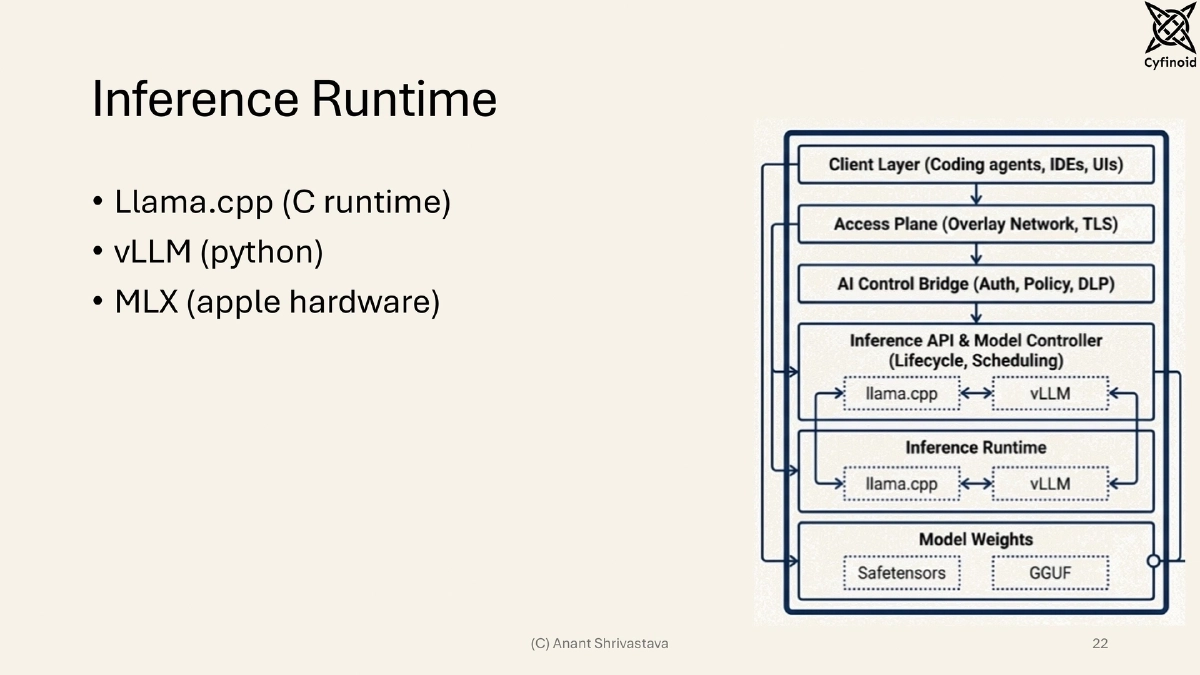
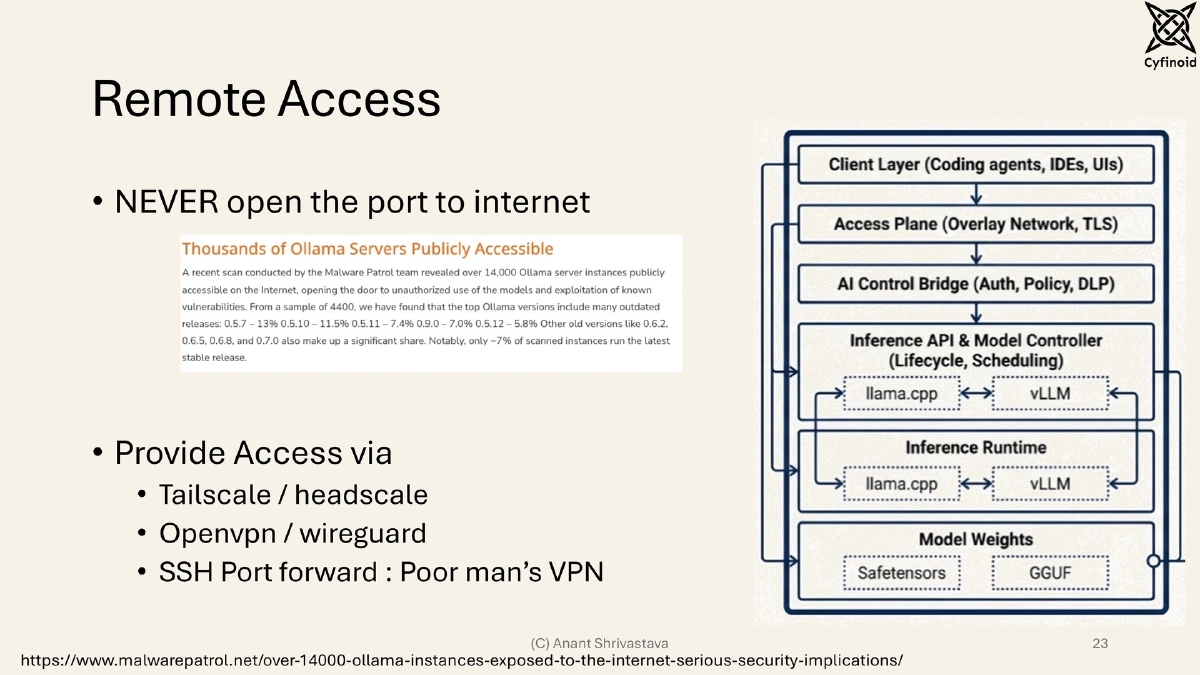
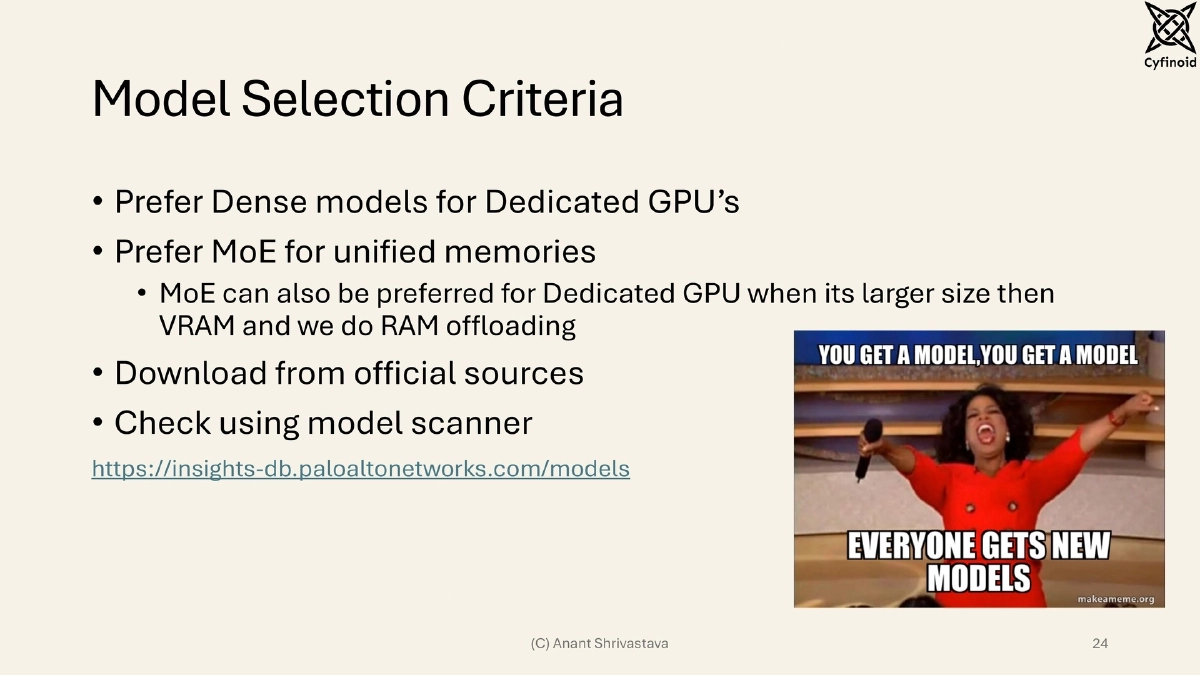
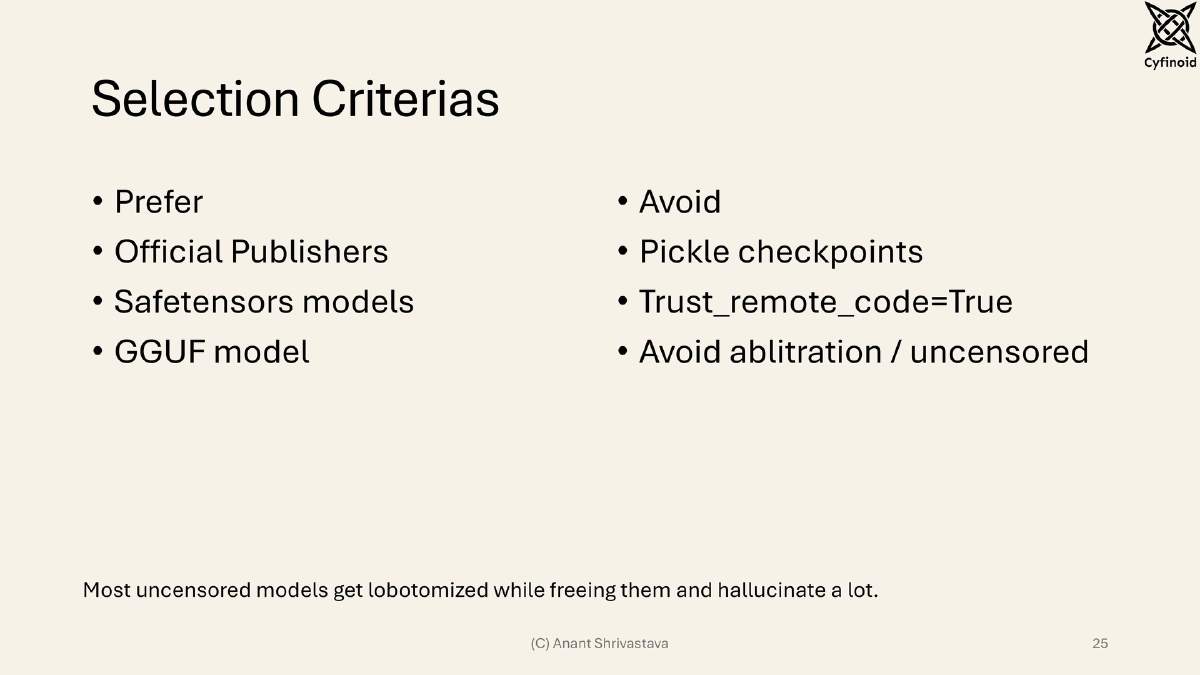
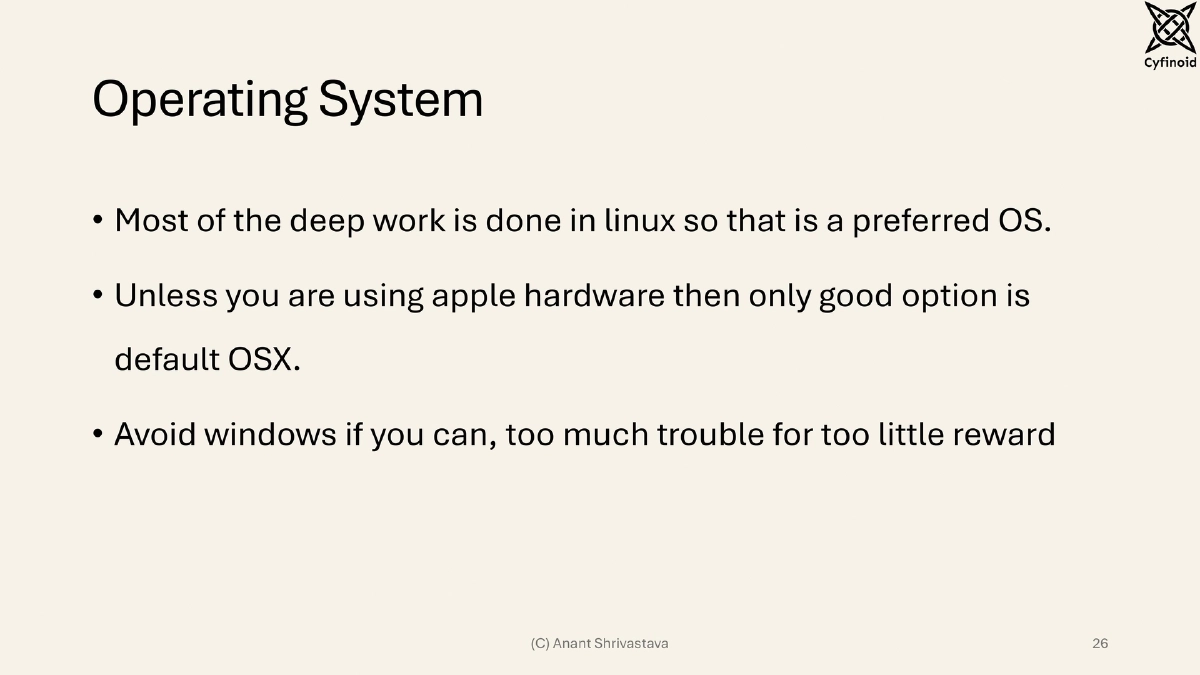
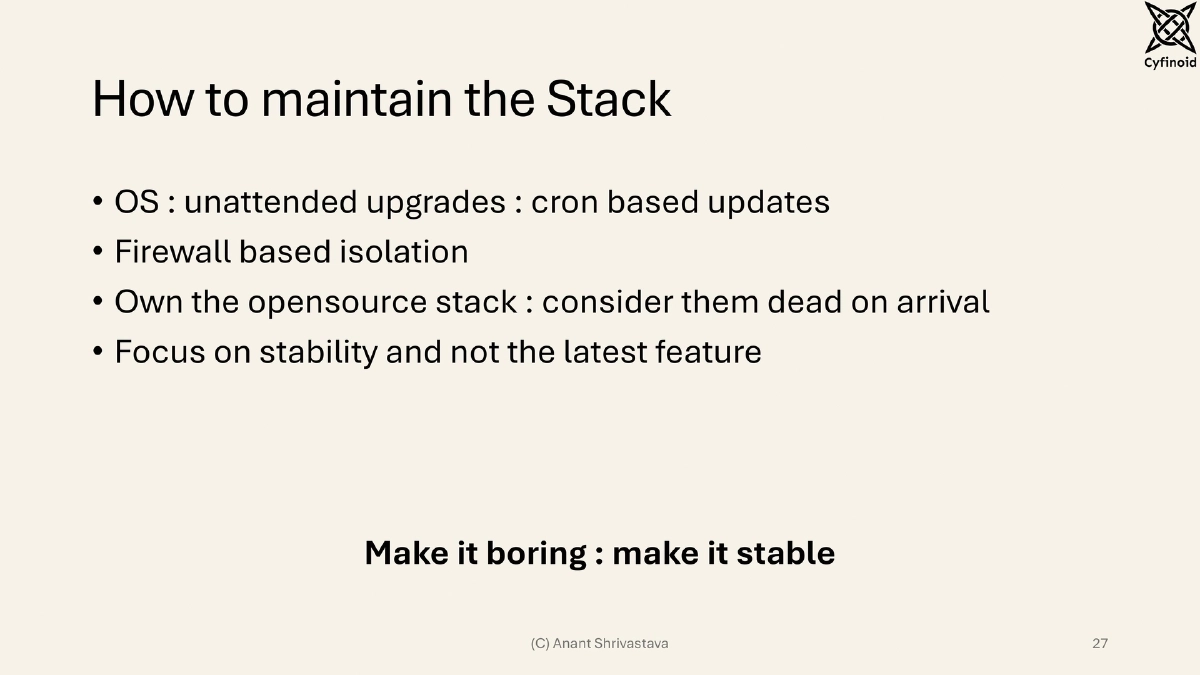
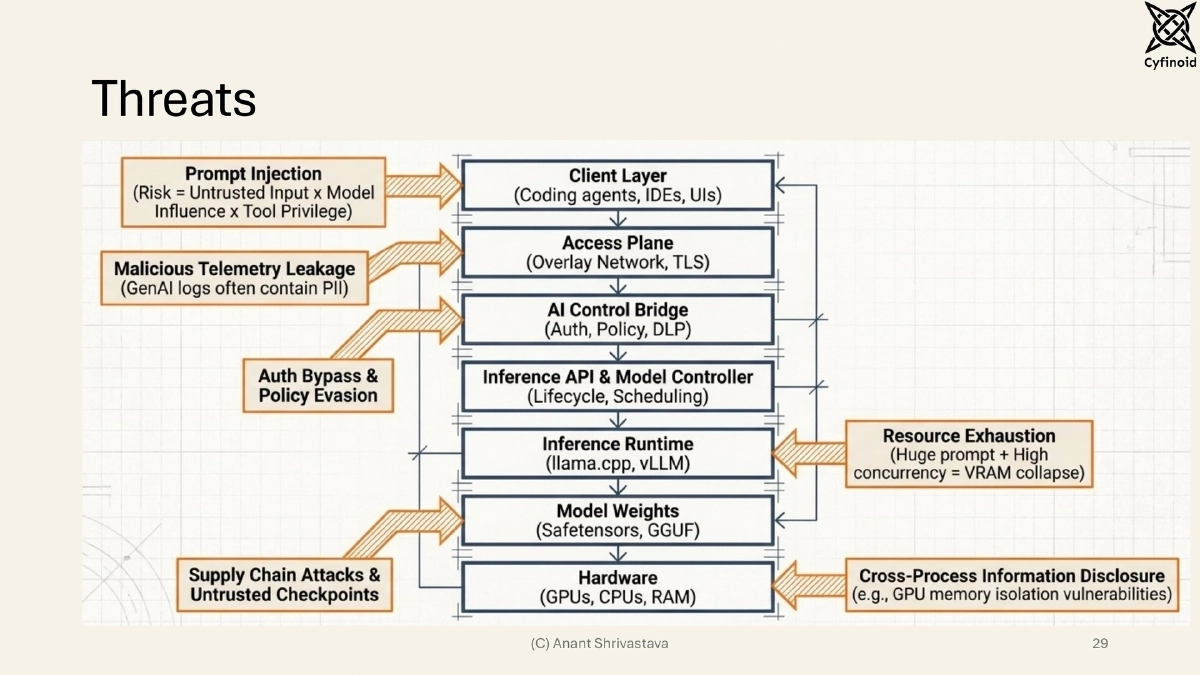
The software stack is drawn in layers: client, access plane, AI control bridge, inference API and model controller, inference runtime, and model weights. Gateways named are Ollama, LM Studio and llama-swap, with a customized fork linked; runtimes are llama.cpp, vLLM and MLX. Remote access follows one rule, never open the port to internet: Tailscale or headscale, OpenVPN or wireguard, or SSH port forwarding as the poor man’s VPN. Model selection prefers dense on dedicated GPUs and MoE on unified memory, official sources and model scanners, while pickle checkpoints, trust_remote_code=True and uncensored models are rejected as lobotomized and hallucination-prone. Maintenance runs unattended upgrades, firewall isolation and stability over the latest feature: make it boring, make it stable.
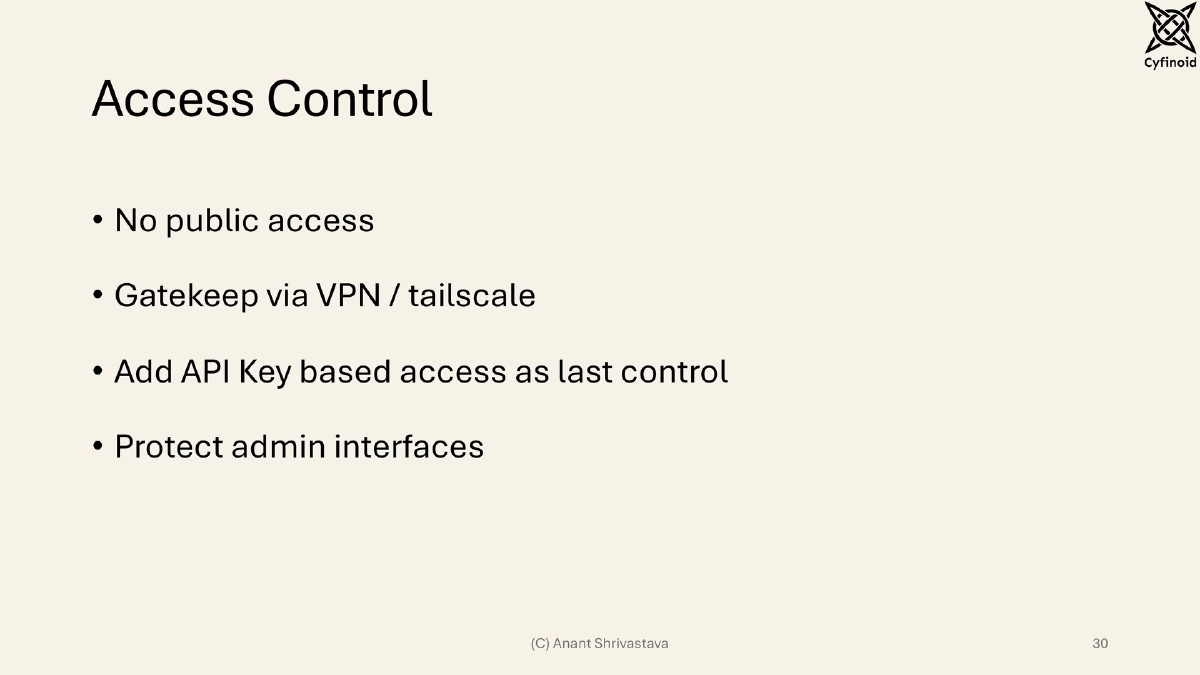
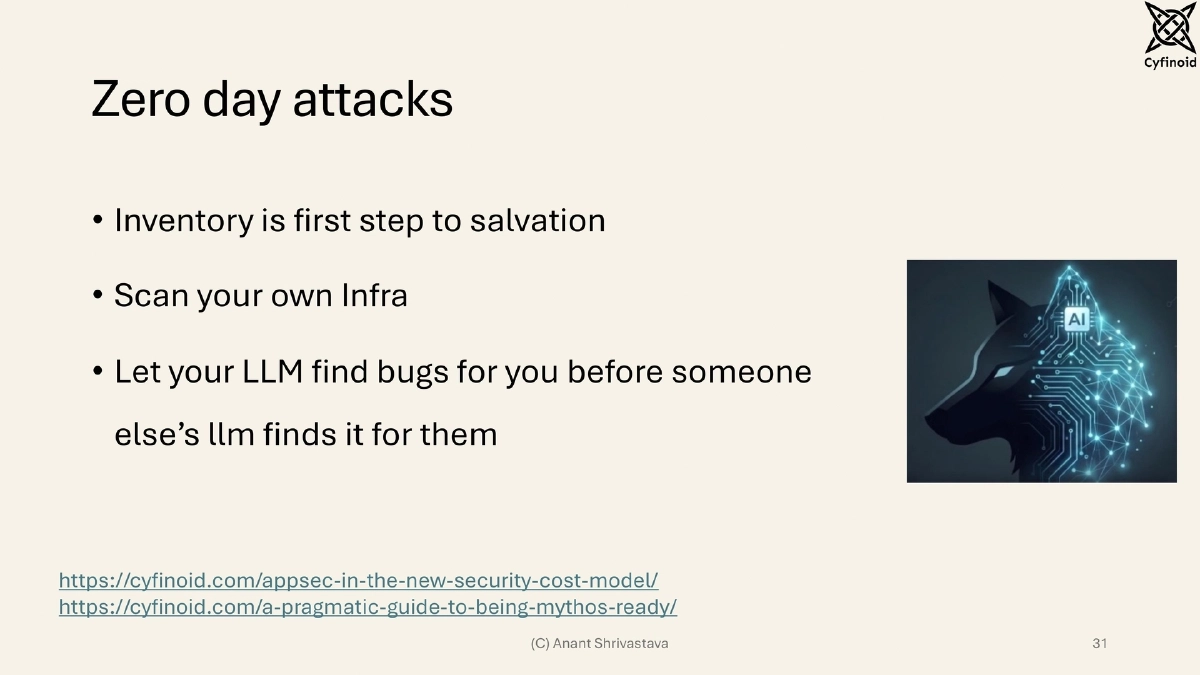
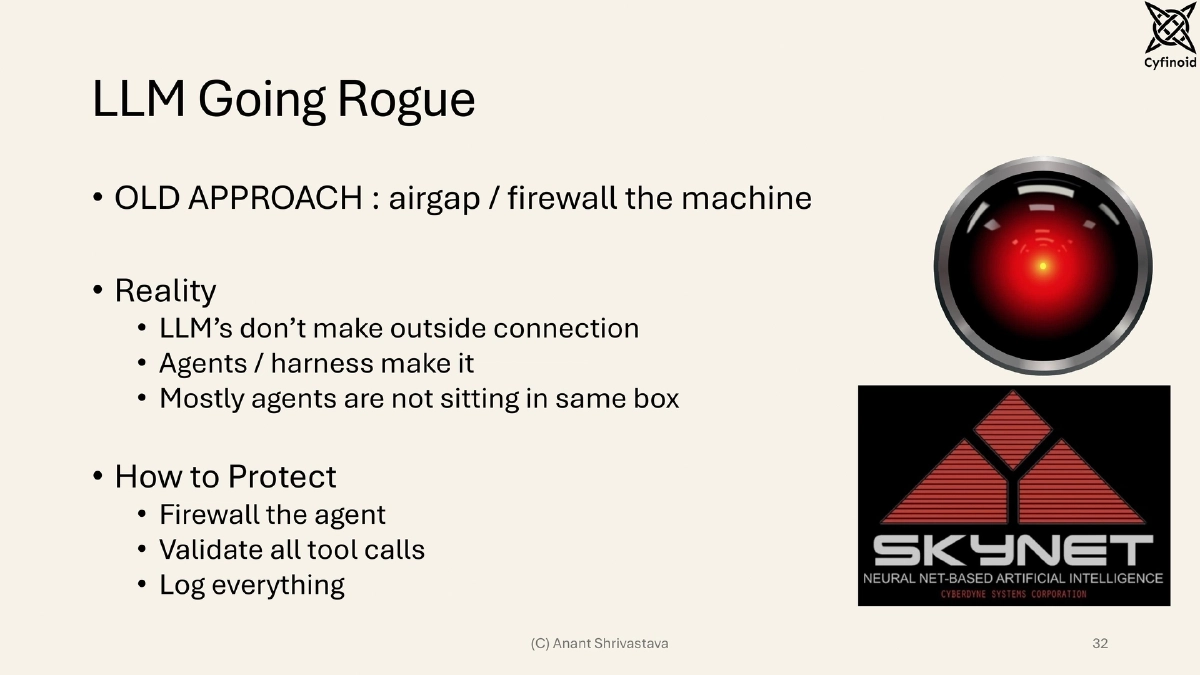
Security takes the last stretch. Access control stacks no public access, VPN or Tailscale gatekeeping, API keys as the last control, and protected admin interfaces. The zero day slide says inventory is the first step to salvation, scan your own infrastructure, and let your LLM find bugs first. LLM going rogue replaces the old airgap answer with the agent reality: LLMs do not make outside connections, agents and harnesses do, mostly from a different box, so firewall the agent, validate all tool calls and log everything. An overlooked slide treats the GPU as a software stack that can leak data, crash or damage hardware, answered by watching update channels and reducing the blast radius; a final slide lists auth bypass, PII leakage and resource exhaustion, solved by age-old methods, nothing LLM specific. A decision flowchart maps data privacy, regulatory compliance and sustained high-throughput into private AI required, preferred or public SaaS preferred, or the simple want of full control.
Key Themes
- control, not cheapness: private AI is ownership of stack, model choice and data residency, and it stays costlier than SaaS per invocation once hardware, electricity and ownership are counted.
- the rented middle: shared SaaS platforms converge on rules that fit the broad middle and often fit nobody perfectly, on top of per-token pricing and mood-driven rate limits.
- receipts against renting: training toggles, cannot-rule-out statements, malicious LLM routers and model substitution cases make the data-use risk concrete rather than hypothetical.
- responsibility splits by approach: home hardware, data center hardware and cloud renting move host, network, power and environment between user and provider, with the cost shape changing accordingly.
- two hardware paths and a vram budget: dense GPUs versus unified memory Mixture-of-Experts boxes, weights plus cache plus buffer plus concurrency, and the model quantized before the cache.
- make it boring: linux as the base, unattended upgrades, firewall isolation, opensource owned and maintained, and stability chosen over the latest feature.
- the security half: access control, inventory, agent containment, GPU bugs and the obvious classics, all treated as age-old security problems rather than LLM-specific ones.
- a decision flow, not a sales pitch: data sensitivity, regulation and sustained high-throughput argue for private AI, delay-tolerant workloads stay on SaaS, and wanting full control is its own reason.
Notable Points
- The screenshot wall cites an OpenAI statement that it cannot rule out de-identified usage data improving its models, and OpenRouter toggles for paid and free endpoints that train on request data, prompt publishing and a 1% data discount in workspaces.
- The researcher receipt: 26 LLM routers secretly injecting malicious tool calls, one client drained of a $500k wallet, roughly 400 hosts takeable within hours, tied to the paper “Your Agent Is Mine: Measuring Malicious Intermediary Attacks on the LLM Supply Chain”.
- The Anthropic report receipt (GTG-50029) covers hacktivists targeting European political and affiliated entities; GTG-16002 alleges Moonshot served Claude instead of Kimi, relaying almost 300,000 customer requests over ten days through 5,380 fraudulent accounts.
- Hardware numbers: RTX Pro 6000 at 96 GB is the largest consumer level single GPU, a server class GB200 carries 372 GB, an NVIDIA GB200 NVL72 cluster reaches 13.4 TB, unified memory tops out around 512 GB on a Mac Studio, and multiple devices can be combined via dedicated cables.
- Power math: RTX Pro 5000 draws 300 watts for 48 GB while the RTX 5090 draws 575 watts for 32 GB, with GPUs running above 70 degrees Celsius on noise-first fan curves.
- The stack diagram names the layers: Client Layer (coding agents, IDEs, UIs), Access Plane (overlay network, TLS), AI Control Bridge (auth, policy, DLP), Inference API & Model Controller (lifecycle, scheduling), Inference Runtime, and Model Weights (safetensors, GGUF).
- Access control guidance stacks four measures: no public access, gatekeeping via VPN or Tailscale, API key based access as the last control, and protected admin interfaces.
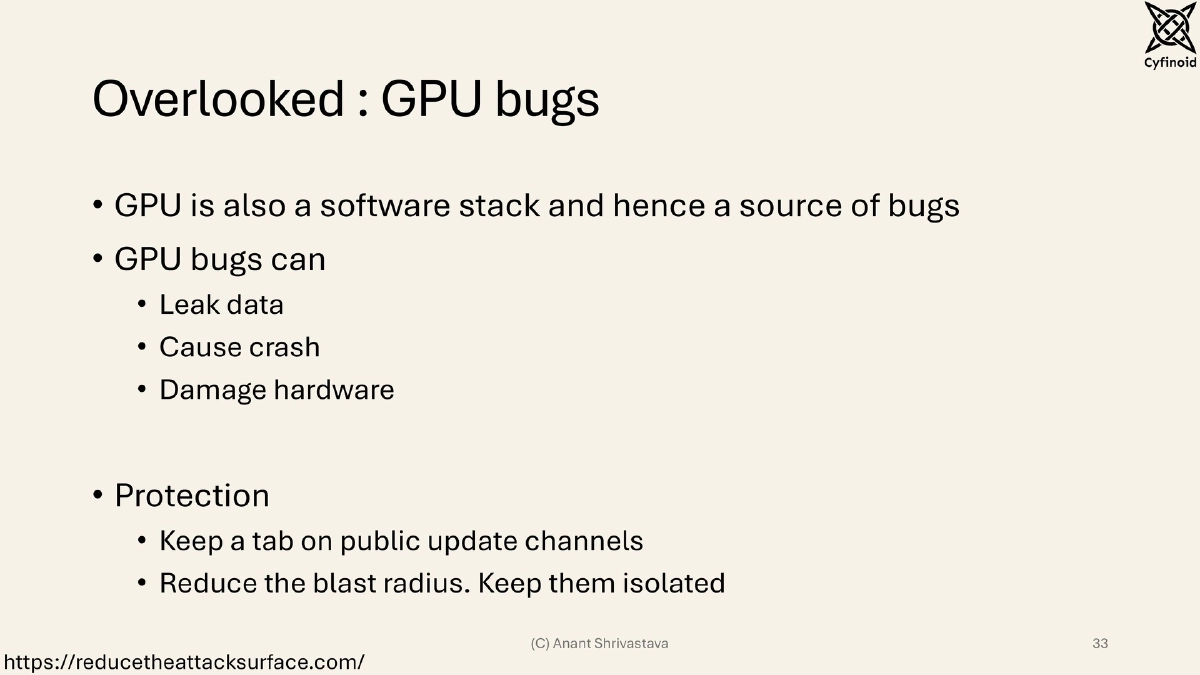
- The GPU bugs slide treats the GPU as a software stack that can leak data, cause crashes or damage hardware, answered by watching public update channels and reducing the blast radius, with reducetheattacksurface.com cited.
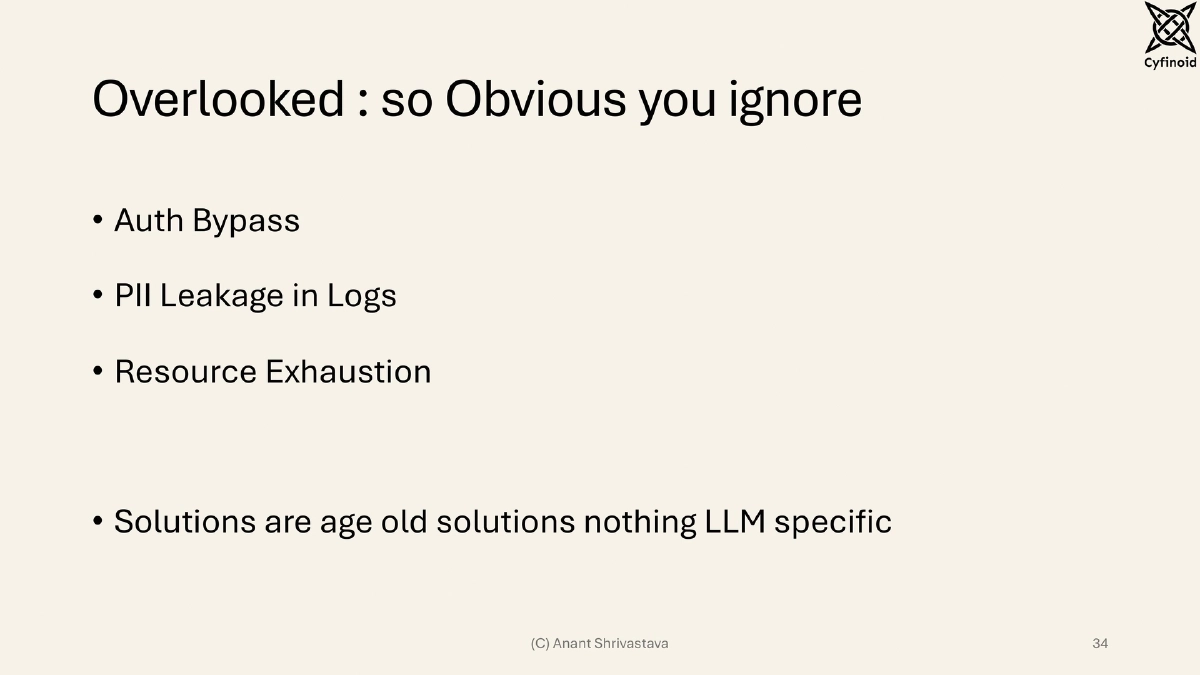
- The overlooked risks slide lists auth bypass, PII leakage in logs and resource exhaustion, with the note that solutions are age-old solutions, nothing LLM specific.
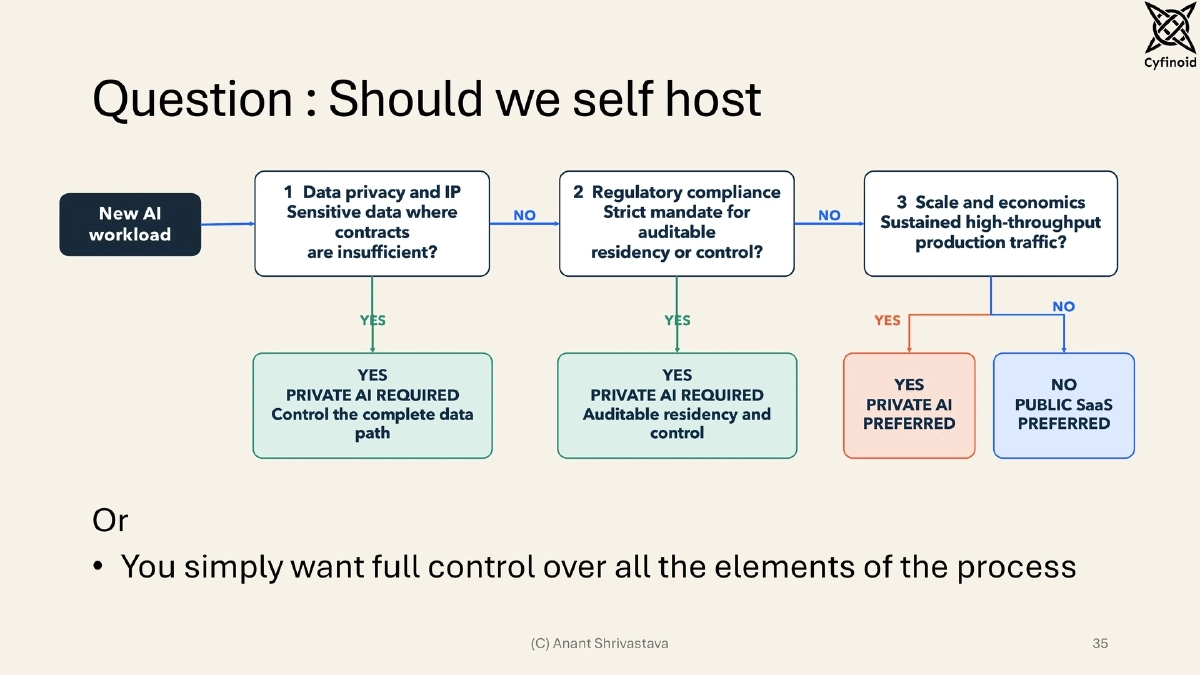
- The decision flow ends in three states, PRIVATE AI REQUIRED (control the complete data path; auditable residency and control), PRIVATE AI PREFERRED (sustained high-throughput production traffic) and PUBLIC SaaS PREFERRED, alongside the option of simply wanting full control over all the elements of the process.
Notable Quotes
“For SaaS you are 1 in million”
“Shared systems converge on rules that fit the broad middle - and often fit nobody perfectly”
“Private never means free or low cost or cheap.”
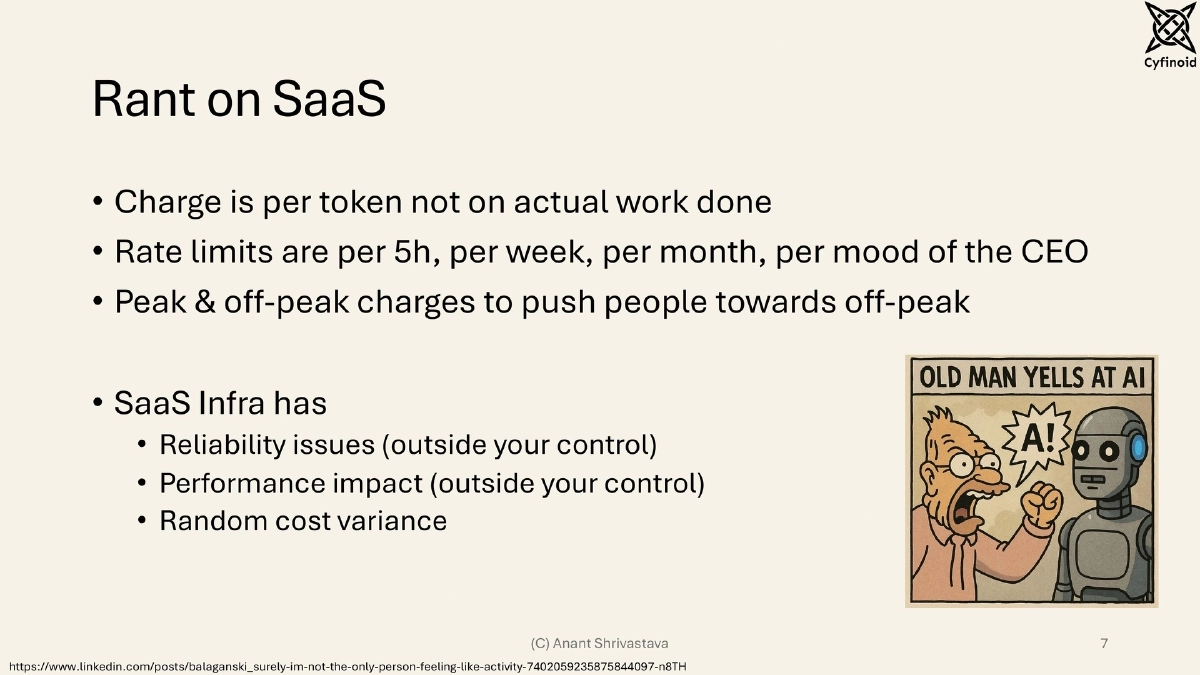
“Charge is per token not on actual work done”
“Inventory is first step to salvation”
“Let your LLM find bugs for you before someone else’s llm finds it for them”
“Make it boring : make it stable”
“you build it, you own it. if you dont secure it: someone else will own it.”